

Your guitar should feel effortless to play.
But if you’re constantly battling tuning issues, uncomfortable action, or dull, lifeless tone, you might assume:
- “Maybe I just need to get better.”
- “Maybe my guitar isn’t good enough.”
- “Maybe this is just how guitar is supposed to feel.”
But here’s the truth: Most guitarists don’t realize how much their instrument is holding them back.
A full setup—adjusting the truss rod, action, intonation, and nut—can completely transform the way your guitar feels and plays. But if you’re not ready to dive into that just yet, there are still quick, simple tweaks you can make right now that will dramatically improve your guitar’s playability.
In this guide, you’ll discover three easy fixes that:
✔ Help your guitar stay in tune longer
✔ Make bending and playing feel smoother
✔ Improve your guitar’s clarity, sustain, and tone
Each of these takes just a few minutes, requires no special tools, and can make a noticeable difference in how your guitar plays today.
Fix #1: Stretch Your Strings to Keep Your Guitar in Tune

Why this matters:
Ever notice how your guitar sounds perfectly in tune when you first tune it, but a few minutes later, it’s already going sharp or flat?
Even if you’ve tuned carefully, your strings may still be slipping out of tune—especially if they’re new or haven’t been properly stretched.
This happens because when you put on fresh strings, they’re not fully settled onto the tuning pegs, nut, and bridge. They slowly stretch out as you play, causing the tuning to drift.
The fix? Manually stretching your strings so they settle faster.
Quick Fix: How to Stretch Your Strings Properly
You can fix this in under a minute—here’s how:
1️⃣ Tune your guitar perfectly using a tuner.
2️⃣ Grab the low E string at the 12th fret and gently pull it upward about an inch.
❗Don’t yank—just firm, steady stretching.
3️⃣ Move up and down the string, stretching in 3-4 spots.
4️⃣ Retune the string, then repeat the process.
5️⃣ Do this for each string until the tuning holds steady after stretching.
🎸 Pro Tip: If your guitar still won’t stay in tune after stretching, the problem might be friction at the nut or slipping tuners—which we cover inside Pro At Home.
Fix #2: Lubricate Your Nut for Smoother Tuning
Why this matters:
Ever tune your guitar perfectly, only to have it go out of tune after just a few bends or using the whammy bar?
This is often caused by friction at the nut—the small slots where your strings pass over before reaching the tuners.
If the string gets stuck in the nut, it won’t return to its proper tension after bending or tuning. Instead, it snaps back out of tune, making you think there’s something wrong with your tuners (or worse, your guitar).
The good news? You can fix this in seconds with a simple trick.
Quick Fix: How to Lubricate Your Nut for Smooth Tuning
You don’t need expensive gear—just a pencil. The graphite inside acts as a natural lubricant that helps the strings slide freely, reducing tuning issues.
Here’s how to do it:
1️⃣ Loosen each string slightly so you can lift it out of the nut slot.
2️⃣ Take a regular pencil and rub the graphite into each nut slot.
❗Focus on where the string sits—it should leave behind a thin layer of graphite.
3️⃣ Put the string back in place and retune.
4️⃣ Repeat for all six strings.
🎸 Pro Tip: For an even smoother fix, use a specialized nut lubricant like Big Bends Nut Sauce or Graphit-All.
Fix #3: Adjust Your Pickup Height for Better Tone & Sustain
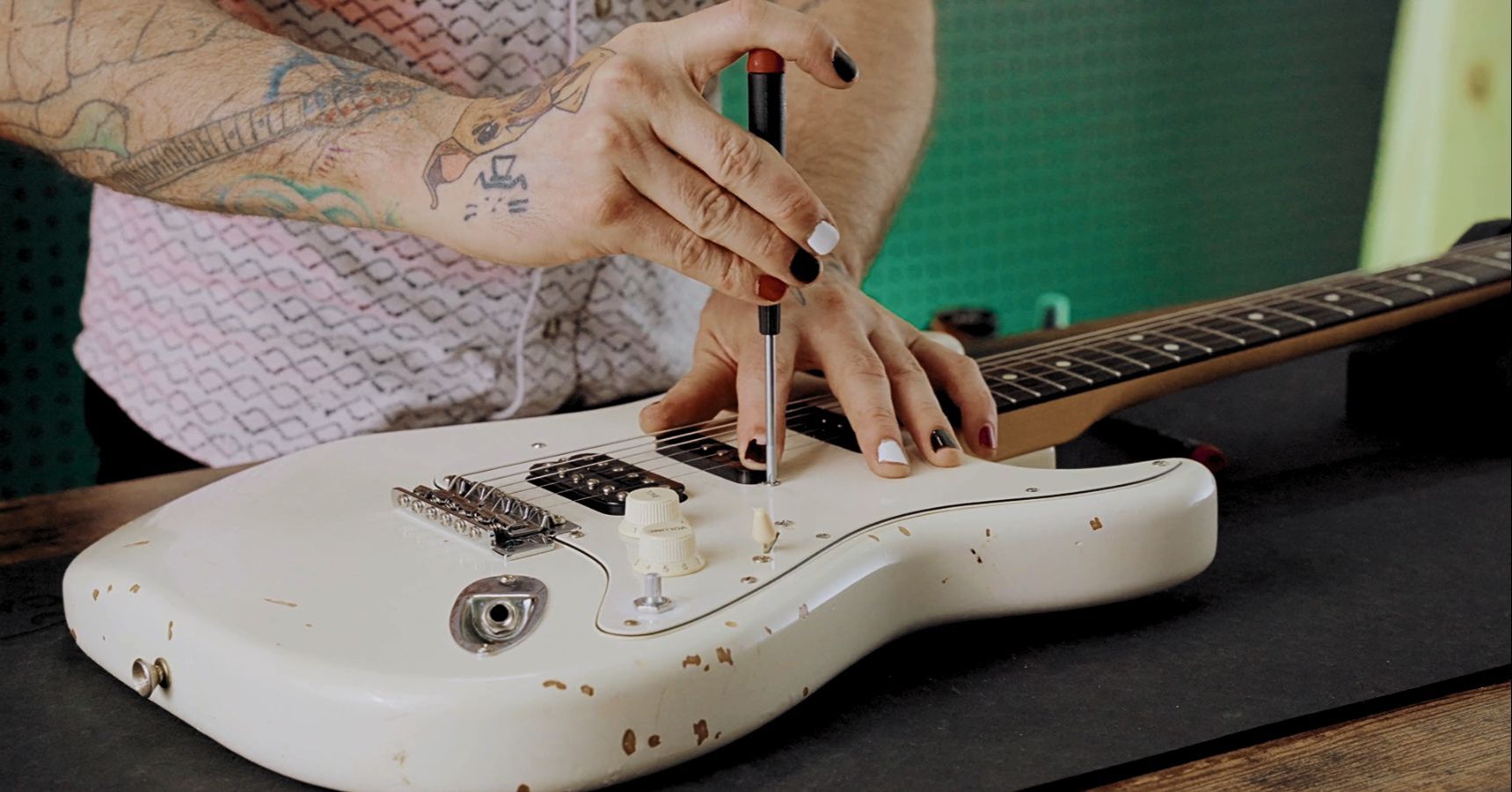
Why this matters:
Ever feel like your guitar sounds weak, muddy, or harsh no matter how much you tweak your amp settings?
Your pickup height might be the problem.
If your pickups are too low, your tone will sound thin and lack power. If they’re too high, they can actually pull on the strings, causing tuning instability and reducing sustain.
Luckily, adjusting your pickup height is one of the easiest (and most overlooked) ways to instantly improve your tone.
Quick Fix: How to Adjust Your Pickup Height
All you need is a screwdriver and a few minutes:
1️⃣ Press down on the last fret of your guitar (this ensures a consistent measurement).
2️⃣ Check the gap between the string and the pickup at the low E and high E sides.
❗For single-coil pickups (Strats, Teles, etc.): About 2mm (roughly the thickness of a nickel).
❗For humbuckers (Les Pauls, SGs, etc.): About 3mm (slightly thicker than a nickel).
3️⃣ Use a screwdriver to raise or lower the pickup height by turning the screws on either side of the pickup:
❗If your tone is weak or lacks power, turn the screws clockwise to raise the pickups.
❗If your notes sound wobbly or distorted, turn the screws counterclockwise to lower them.
4️⃣ Test your sound after each small adjustment to find the sweet spot.
🎸 Pro Tip: Set your neck pickup slightly lower than your bridge pickup for balanced volume and warmth.
Your Guitar Feels Better—But Is It Fully Setup?
By now, you’ve made a few quick tweaks that should improve your tuning stability, playability, and tone.
But here’s the thing—these are just small adjustments.
A truly great-playing guitar isn’t just about fixing little issues here and there. It’s about making sure everything works together:
- The neck relief is set correctly so the action feels comfortable.
- The action and saddle height match your playing style.
- The intonation is dialed in so every note sounds in tune across the fretboard.
- The nut and bridge are set up properly so you’re not fighting against hidden friction points.
These fixes can take a guitar from feeling okay to feeling like an absolute dream to play.
If your guitar still doesn’t feel quite right, don’t worry—that’s normal. Every player, no matter their skill level, benefits from a proper setup. The good news? You can learn to do it yourself, and it’s easier than you think.
Taking the time to understand how your guitar works, and making adjustments when needed, is one of the best things you can do as a guitarist. Not only will your playing feel better, but you’ll also save money and have the confidence to tweak your instrument anytime it needs it.
So if you’ve ever felt like your guitar wasn’t quite working with you, now you know—you don’t have to settle. A great-playing guitar is within your reach!